

About This Episode
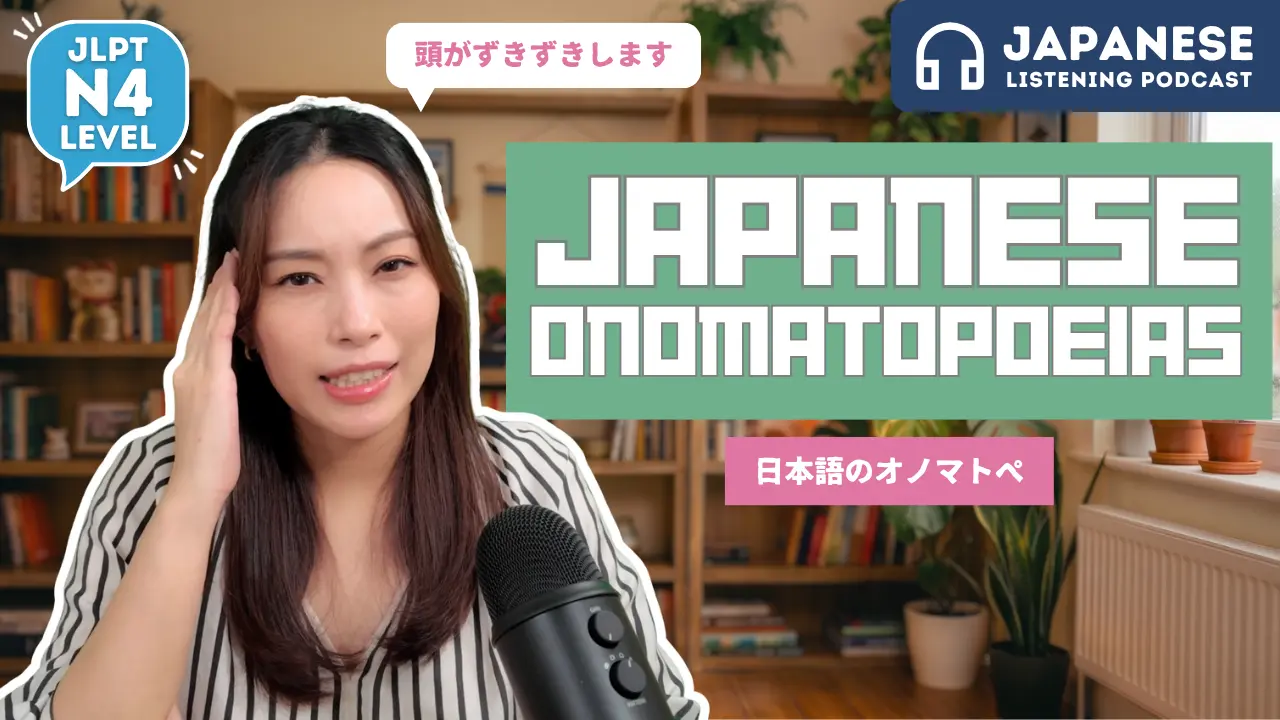
Have you ever heard a native Japanese speaker throw in a word like 'waku-waku' or 'pika-pika' and wondered what on earth it meant? In this N4 listening episode, I break down Japanese onomatopoeia, the sound words that make your Japanese feel a lot less like a textbook and a lot more like a native speaker.
Episode Details
Key Vocabulary
Here are the key words and phrases you will hear in this episode.
Grammar Points Covered
Saying what naturally happens with 〜と
Plain form + と means whenever or if you do A, B naturally follows.
Example: 実は、オノマトペを使うと、日本語がもっと自然で生き生きした感じになります。
Actually, when you use onomatopoeia, your Japanese starts to feel more natural and lively.
Setting a condition with 〜ば
Change the verb's final u-sound to e and add ば to say if A happens, then B.
Example: 逆に言うと、オノマトペを覚えれば、複雑な文法を使わなくても、気持ちを上手に伝えることができます。
Put the other way, if you learn onomatopoeia, you can express your feelings well even without using complicated grammar.
Comparing two ways of saying something with 〜より〜ほうが
Put the weaker option before より and the better one before ほうが.
Example: 頭が痛いとき、ただ「痛いです」と言うより、「頭がずきずきします」と言うほうが、より自然に聞こえます。
When your head hurts, saying 'atama ga zuki-zuki shimasu' sounds more natural than just saying 'it hurts.'
Episode Transcript
Follow along while you listen. Japanese script first, then the English translation below.
Japanese (日本語)
みなさんこんにちは!みなさんは、「ピカピカ」や「わくわく」ということばを聞いたことがありますか。これは日本語の「オノマトペ」、つまり音や気持ちを表すことばです。今日のレベルはJLPT N4です。少し難しいですが、ゆっくり話しますので安心してください。教科書の日本語は、正しいですが、少し硬く感じませんか。
実は、オノマトペを使うと、日本語がもっと自然で生き生きした感じになります。今日は、日常生活で使われているオノマトペについて、一緒に見ていきましょう。まず、オノマトペとは何かを簡単に説明します。オノマトペは、音や様子、気持ちを表す短いことばのグループです。
英語にも「バン」や「ドキドキ」に似たことばがありますが、日本語はその数がとても多いです。例えば、雨の音だけでも、「ザーザー」「パラパラ」「しとしと」など、いろいろな言い方があります。文法を正しく勉強しても、このオノマトペを知らないと、ネイティブの会話についていけないことがあります。逆に言うと、オノマトペを覚えれば、複雑な文法を使わなくても、気持ちを上手に伝えることができます。
アニメやマンガ、友達との会話にも、オノマトペはたくさん出てきます。だから、オノマトペは、文法と自然な会話をつなぐ「近道」だと言われています。それでは、まず自然や体の状態を表すオノマトペから紹介します。天気の話をすると、雨が強く降っているとき、「ザーザー降っている」と言います。
一方で、雨が弱く降っているときは、「パラパラ降っている」と表現します。同じ「雨が降る」でも、音を変えるだけで、強さの違いが伝わりますね。次に、星や宝石が輝いているとき、「ピカピカ光っている」と言います。新しい靴や、掃除した後の部屋にも、「ピカピカ」がよく使われます。
もし部屋がピカピカだったら、誰でも気持ちがいいと感じるはずです。雷の音を表すときは、「ゴロゴロ」を使います。面白いことに、「ゴロゴロ」は、人が家で何もせずに寝転んでいる様子にも使われます。つまり、一つのオノマトペが、状況によって違う意味になることがあります。
これは辞書だけでは覚えにくいので、実際の会話の中で少しずつ慣れていく必要があります。また、髪の毛がなめらかなとき、「サラサラの髪」と言います。水が静かに流れる様子にも、「サラサラ」が使われます。このように、繰り返しの音を使うと、長い説明をしなくても、頭の中にイメージが浮かびます。
例えば、「なめらかで美しい髪です」と言う代わりに、「サラサラの髪です」と言えば、一言で伝わります。これが、オノマトペが難しい文法の代わりになる、一つの理由です。ここまでは、自然や物の様子を表すオノマトペを見てきました。クイズです!そうじしたへやや、あたらしいくつにつかうオノマトペは、どれですか。
次は、私たちの気持ちや体の感覚を表すオノマトペに移りましょう。旅行の前や、好きな人に会う前、心が弾むとき、「わくわくする」と言います。この「わくわく」は、楽しいことを待っているときの、明るい気持ちを表しています。一方で、心臓が速く動くときは、「どきどきする」と言います。
面接を受けるときや、好きな人の前で緊張するとき、心臓がどきどきしますよね。面白いのは、「わくわく」も「どきどき」も、心臓が速く動くという点では似ていることです。でも、「わくわく」は楽しい期待で、「どきどき」は緊張や不安を含むことが多いです。次に、待たされたり、物事がうまくいかなかったりするとき、「いらいらする」と言います。
電車が遅れて待たされたら、いらいらしてしまう人も多いでしょう。体の感覚を表すオノマトペもあります。頭が痛いとき、ただ「痛いです」と言うより、「頭がずきずきします」と言うほうが、より自然に聞こえます。お腹がとても空いているときは、「お腹がぺこぺこです」と言います。
このような表現を覚えておくと、病院で症状を説明するときにも役に立ちます。例えば、医者に「頭がずきずき痛みます」と言えば、痛みの種類がすぐに伝わります。このように、感情や感覚を表すオノマトペは、日常会話でとてもよく使われています。クイズです!おなかがとても空いているときにつかうオノマトペは、どれですか。
N4の文法を勉強している皆さんなら、もうこれらのことばを、簡単な文に入れることができるはずです。「明日、旅行に行くので、わくわくしています」のように、そのまま文に入れれば大丈夫です。難しい文法を考えなくても、気持ちがはっきり伝わるのが、オノマトペのいいところです。では、こうしたオノマトペを、実際の生活でどう使えばいいか、具体的に見ていきましょう。
まず、レストランで食べ物を注文するときの例です。揚げ物が新鮮で音がするとき、「ぱりぱりしていておいしい」と言います。お餅やパンが柔らかいときは、「もちもちしていて美味しい」と表現します。メニューに「もちもち食感」と書いてあったら、それは柔らかくて弾力があるという意味です。
このように、初めて聞くオノマトペでも、前後の文や状況から意味を推測できることがあります。例えば、パリパリという音から、硬くて割れやすいものだと想像できますよね。次は、SNSでよく見る使い方です。友達がとても面白い動画を見て、「げらげら笑ってしまった」と投稿することがあります。
また、いつも機嫌がよくて笑顔の人には、「いつもにこにこしている」と言います。このようなオノマトペを知っていると、日本の友達のSNSの投稿も、もっと楽しく読めるようになります。では、知らないオノマトペに出会ったら、どうすればいいでしょうか。クイズです!おもちやパンがやわらかいときにつかうオノマトペは、どれですか。
こたえをコメント欄に書いてください。後で、何問合っていたか、コメントで返事しますね。まず、同じ音が二回繰り返されていることに注目してください。そして、前後の文を見て、それが良いことか悪いことかを考えます。例えば、「げらげら」は明るい音なので、楽しい場面で使われることが多いと推測できます。
一方、「いらいら」のような音は、少しネガティブな感じがしますよね。このように、音のイメージから意味を推測する練習を続けると、辞書がなくても理解できるオノマトペが増えていきます。最初は難しく感じても、続けていくうちに、自然に感覚がつかめるようになります。皆さんも、アニメやドラマを見るとき、オノマトペに注意して聞いてみてください。
さて、ここで皆さんに質問です。今、あなたの気持ちを一つのオノマトペで表すなら、どれを選びますか。「わくわく」ですか、それとも「どきどき」でしょうか、コメント欄で教えてください。きっと、今まで気づかなかったオノマトペが、たくさん見つかるはずです。
今日は、日常生活で使われているオノマトペについて、たくさん紹介しました。「ピカピカ」「ザーザー」のような自然の音から、「わくわく」「どきどき」のような気持ちまで、理解できましたか。オノマトペを使うだけで、皆さんの日本語は、教科書っぽさが減って、ずっと自然に聞こえるようになります。ぜひ、今日習ったことばを、明日の会話で一つでも使ってみてください。
ただ、オノマトペのニュアンスは、アプリや本だけで覚えるのは、実は少し難しいです。いつ、どんな場面で使えば自然なのか、一人で勉強していると、なかなか自信が持てませんよね。音のタイミングや使い方は、誰かと実際に話しながら練習すると、もっと早く身につきます。今日覚えた「わくわく」や「どきどき」も、実際に使ってみて、初めて自分のことばになります。
今日の動画が、皆さんの日本語の勉強に少しでも役に立てば嬉しいです。さあ、今日のオノマトペの旅は、ここで一段落です。今日は、「ピカピカ」から「どきどき」まで、日常生活のオノマトペをたくさん学びました。でも、こうしたことばを本当に使えるようになるには、聞くだけでなく、実際に先生と話して直してもらうことが必要です。
私はJapademyという学校で教えていて、最大8人までの少人数クラスで、ネイティブの先生が丁寧に指導しています。これまでに700人以上の生徒さんが学んでいて、94パーセントの人がコースを最後まで終えています。興味がある方は、概要欄のリンクから、JLPT対策コースの無料体験レッスンに申し込んでみてください。また次の動画でお会いしましょう。ありがとうございました!
English Translation
Hello, everyone! Have you ever heard words like 'pika-pika' or 'waku-waku'? These are Japanese 'onomatope' words that express sounds or feelings. Today's level is JLPT N4. It's a little difficult, but I'll speak slowly, so don't worry. Textbook Japanese is correct, but doesn't it feel a little stiff?
Actually, when you use onomatopoeia, your Japanese starts to feel more natural and lively. Today, let's look together at the onomatopoeia people use in everyday life. First, let me briefly explain what onomatopoeia is. Onomatopoeia is a group of short words that express sounds, states, or feelings.
English also has words similar to 'bang' or 'dokidoki,' but Japanese has a lot more of them. For example, just for the sound of rain, there are many ways to say it, like 'zaa-zaa,' 'para-para,' or 'shito-shito.' Even if you study grammar correctly, if you don't know this kind of word, you can end up unable to keep up with native conversation. Put the other way, if you learn onomatopoeia, you can express your feelings well even without using complicated grammar.
Onomatopoeia shows up a lot in anime, manga, and conversations with friends, too. That's why onomatopoeia is said to be the 'shortcut' that connects grammar and natural conversation. Well then, let's start by introducing onomatopoeia that describes nature or the state of the body. Speaking of weather, when rain is falling hard, we say it's 'zaa-zaa futte iru.'
On the other hand, when rain is falling lightly, we express it as 'para-para futte iru.' Even with the same 'rain falling,' just by changing the sound, you can convey the difference in intensity, right? Next, when stars or jewels are sparkling, we say they're 'pika-pika hikatte iru.' 'Pika-pika' is often used for new shoes, too, or a room right after you've cleaned it.
If your room is pika-pika clean, anyone would feel good about it. When describing the sound of thunder, we use 'goro-goro.' Interestingly, 'goro-goro' is also used for someone lying around at home doing nothing. In other words, a single onomatopoeia can take on a different meaning depending on the situation.
This is hard to learn from a dictionary alone, so you need to get used to it little by little through real conversation. Also, when your hair is smooth, we call it 'sara-sara no kami.' 'Sara-sara' is also used for the way water flows quietly. This way, when you use a repeated sound, an image comes to mind without needing a long explanation.
For example, instead of saying 'it's smooth, beautiful hair,' if you say 'it's sara-sara hair,' it comes across in one word. This is one reason onomatopoeia can take the place of difficult grammar. So far, we've looked at onomatopoeia that describes nature or the state of things. Quiz time! Which onomatopoeia do we use for a freshly cleaned room or new shoes?
Next, let's move on to onomatopoeia that expresses our feelings or physical sensations. Before a trip, or before meeting someone you like, when your heart feels light, we say 'waku-waku suru.' This 'waku-waku' expresses the bright feeling you have while waiting for something fun. On the other hand, when your heart beats fast, we say 'dokidoki suru.'
When you're having an interview, or feeling nervous in front of someone you like, your heart goes dokidoki, right? What's interesting is that both 'waku-waku' and 'dokidoki' are similar in that your heart beats fast. But 'waku-waku' is happy anticipation, while 'dokidoki' often includes nervousness or anxiety. Next, when you're kept waiting, or when things aren't going well, we say 'ira-ira suru.'
If your train is late and you're kept waiting, a lot of people probably end up feeling ira-ira. There's also onomatopoeia that describes physical sensations. When your head hurts, saying 'atama ga zuki-zuki shimasu' sounds more natural than just saying 'it hurts.' When you're really hungry, we say 'onaka ga peko-peko desu.'
If you remember expressions like this, they'll help you when explaining your symptoms at the hospital, too. For example, if you tell the doctor 'my head hurts with a zuki-zuki pain,' the type of pain comes across right away. As you can see, onomatopoeia that expresses emotions or sensations is used very often in everyday conversation. Quiz time! Which onomatopoeia do we use when you're really hungry?
If you're studying N4 grammar, you should already be able to drop these words into simple sentences. Just drop it straight into a sentence, like 'I leave for a trip tomorrow, so I'm waku-waku' that's all you need. The great thing about onomatopoeia is that your feelings come across clearly, even without thinking about difficult grammar. Now, let's take a concrete look at how to actually use this kind of onomatopoeia in real life.
First, here's an example of ordering food at a restaurant. When fried food is fresh and makes a sound, we say it's 'pari-pari and delicious.' When mochi or bread is soft and chewy, we describe it as 'mochi-mochi and delicious.' If the menu says 'mochi-mochi texture,' it means it's soft and has a nice chewy bounce.
This way, even with onomatopoeia you're hearing for the first time, you can sometimes guess the meaning from the surrounding sentence or situation. For example, from the sound 'pari-pari,' you can imagine it's something hard and easy to crack, right? Next is a way of using it that you often see on social media. A friend might watch a really funny video and post that they 'gera-gera waratte shimatta,' burst out laughing.
Also, for someone who's always in a good mood and smiling, we say they're 'always niko-niko.' Knowing onomatopoeia like this means you can enjoy reading your Japanese friends' social media posts even more. So, what should you do when you come across onomatopoeia you don't know? Quiz time! Which onomatopoeia do we use when mochi or bread is soft and chewy?
Please write your answers in the comment section. I'll reply in the comments later and let you know how many you got right. First, notice that the same sound is being repeated twice. Then, look at the surrounding sentence and think about whether it's something good or bad. For example, since 'gera-gera' is a bright sound, you can guess it's often used in fun situations.
On the other hand, a sound like 'ira-ira' feels a little negative, doesn't it? If you keep practicing guessing meaning from the sound's image like this, the onomatopoeia you can understand without a dictionary will keep growing. Even if it feels difficult at first, as you keep at it, you'll naturally start to get a feel for it. When you watch anime or dramas, try paying close attention to the onomatopoeia, too.
Now, here's a question for all of you. If you had to describe how you feel right now with one onomatopoeia, which one would you choose? Is it 'waku-waku,' or maybe 'dokidoki'? Tell me in the comments. I'm sure you'll find a lot of onomatopoeia you never noticed before.
Today, I introduced a lot of onomatopoeia used in everyday life. Were you able to understand everything, from natural sounds like 'pika-pika' and 'zaa-zaa,' to feelings like 'waku-waku' and 'dokidoki'? Just by using onomatopoeia, your Japanese will sound a lot less textbook-like, and much more natural. Please try using even just one of the words you learned today in tomorrow's conversation.
That said, learning the nuance of onomatopoeia from just apps or books alone is actually a little difficult. When you study alone, it's hard to build confidence about when and in what situation to use it naturally, isn't it? You'll pick up the timing and usage of these sounds much faster if you practice by actually talking with someone. Even the 'waku-waku' and 'dokidoki' you learned today only become truly your own words once you actually try using them.
I'd be happy if today's video helps with your Japanese studies, even just a little. Well, today's journey through onomatopoeia comes to a pause here. Today, we learned a lot of everyday onomatopoeia, from 'pika-pika' to 'dokidoki.' But to truly be able to use words like this, listening alone isn't enough. You need to actually talk with a teacher and have them correct you.
I teach at a school called Japademy, where native-speaking teachers give careful guidance in small classes of up to 8 students. More than 700 students have studied with us so far, and 94 percent of them complete the course all the way to the end. If you're interested, please use the link in the description to sign up for a free trial lesson of our JLPT prep course. See you in the next video. Thank you so much for watching!
Frequently Asked Questions
Who is this Japanese listening episode for?
It's made for JLPT N4 learners and intermediate students, usually after about a year of study. If you're comfortable with N5 grammar and some basic kanji, you'll be able to follow along. It fits the intermediate stage of a Japademy course.
What is this episode about?
Kanami Sensei explains Japanese onomatopoeia, the sound words that make everyday Japanese sound natural. She covers words for weather and nature, feelings and body sensations, food textures and social media, and shows you how to guess what a new sound word means.
What vocabulary will I hear?
You'll hear sound words like わくわく (excited), どきどき (heart pounding), ぺこぺこ (very hungry), ピカピカ (sparkling), and もちもち (soft and chewy). Each one comes with a real example, so you'll know exactly when to use it.
How do I get the full transcript?
Subscribe to our free newsletter at japademy.com/japanese-listening-jlpt-n4 and we'll send you the full PDF transcript for this episode, plus new episodes as they're released.
How can I keep improving my Japanese?
Listening is a great start, but speaking is where it really clicks. At Japademy you learn with certified native teachers in small live classes (max 8 students), so you actually talk every lesson. You can book a free trial lesson using the link below or at japademy.com/online-courses.
JLPT preparation online courses
Prepare for the JLPT with certified native teachers and proven exam strategy.