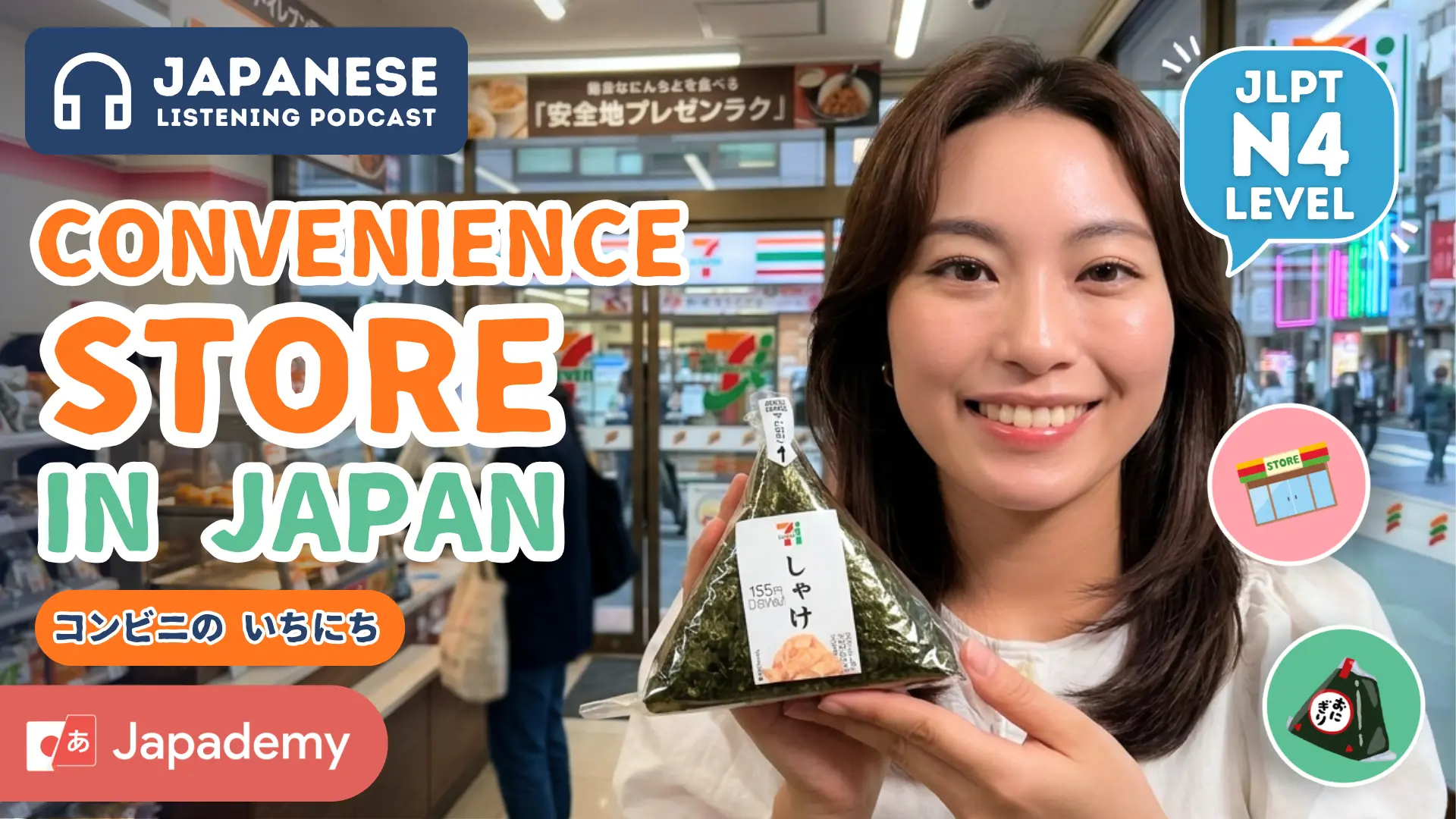


About This Episode
I've got a bit of a confession: I can't walk past a snack aisle in Japan without stopping. In this episode I share my favourite Japanese snacks and treats, from the seasonal limited-edition flavours to the sweet-potato snacks I wait for every autumn. I also tell a story from the years I lived overseas, when I really missed them. It's all at natural N4 speed with full English subtitles.
Episode Details
Key Vocabulary
Here are the key words and phrases you will hear in this episode.
Grammar Points Covered
Using 〜たことがあります to talk about an experience
Add 〜たことがあります to a verb to say you have done something before.
Example: 私(わたし)は、海外(かいがい)に住(す)んでいた ことがあります。
I have lived overseas before.
Using 〜ようになりました to describe a change
Use 〜ようになりました to express reaching a new ability or state that was not true before.
Example: 日本(にほん)に帰(かえ)ってきてから、 かんたんにおかしが買(か)えるようになりました。
Ever since I came back to Japan, I have been able to buy these snacks easily.
Using 〜と思(おも)います to give your opinion
Add 〜と思います to the end of a thought to say what you think.
Example: おかしは、味(あじ)だけじゃなくて、 思(おも)い出(で)もくれると思(おも)います。
I think snacks are not just about flavour; they give you memories too.
Episode Transcript
Follow along while you listen. Japanese script first, then the English translation below.
Japanese (日本語)
皆(みな)さん、こんにちは! 皆(みな)さんは、 日本(にほん)のおかしが 好(す)きですか。 今日(きょう)は、 私(わたし)が大好(だいす)きな 日本(にほん)のおかしについて 話(はな)します。 このチャンネルは、 JLPT N4(エヌよん)レベルの 日本語(にほんご)で 話(はな)しています。 わからないことばがあっても、 だいじょうぶです。 さいごまで聞(き)いてくださいね。
日本(にほん)には、 ほんとうにたくさんのしゅるいの おかしがあります。 新(あたら)しいおかしと、 その時(とき)だけの味(あじ)が、 いつも出(で)ています。 私(わたし)は、 それがとても楽(たの)しいと 思(おも)います。 スーパーやコンビニに行(い)くと、 いつも新(あたら)しいおかしを 見(み)つけます。 何(なに)を買(か)おうか、 いつもまよってしまいます。
今日(きょう)は、 私(わたし)が 大好(だいす)きなおかしと、 きせつの話(はなし)をします。 私(わたし)は、 海外(かいがい)に住(す)んでいた ことがあります。 そのときの経験(けいけん)も、 すこしお話(はな)ししますね。 では、 日本(にほん)のおかしのせかいに、 いっしょに入(はい)りましょう。 まず、 日本(にほん)のおかしのしゅるいの 多(おお) さについて 話(はな)します。
私(わたし)は、 スーパーやコンビニに行(い)くと、 いつも新(あたら)しいおかしを 見(み)つけることができます。 これは、 おかしを作(つく)っている 人(ひと)たちが、 いつも新(あたら)しいアイデアを 考(かんが)えているからだと 思(おも)います。だから、おなじおかしでも、 味(あじ)がどんどん かわっていきます。 たとえば、おなじチョコレートでも、 いろいろな味(あじ)が
売(う)られています。 それを見(み)ると、 私(わたし)はいつも ワクワクしてしまいます。 皆(みな)さんの国(くに)にも、 きせつごとに味(あじ)が かわるおかしはありますか。 日本(にほん)ほど多(おお)くは ないかもしれませんね。 これから、きせつのおかしについて、 少(すこ)しお話(はな)しします。
日本(にほん)には、 はっきりとした四(よ)つの きせつがあります。 春(はる)になると、 さくらの味(あじ)のおかしが たくさん出(で)てきます。ピンク色(いろ)のおかしを 見(み)ると、 春(はる)が来(き)たと感(かん)じます。 そして、秋(あき)になると、 さつまいもとくりの味(あじ)が人気(にんき)になります。 これは、 まさに私(わたし)が一番(いちばん) 好(す)きなきせつです。
春(はる)と秋(あき)を 比(くら)べると、 私(わたし)はやっぱり秋(あき)の ほうが好(す)きです。 秋(あき)のおかしは、あたたかくて、 やさしい味(あじ)がすると 思(おも)います。 皆(みな)さんの国(くに)では、 どのきせつのおかしが一番(いちばん) 人気(にんき)ですか。 日本(にほん)では、 きせつがかわると、 コンビニやスーパーの たなもかわります。
それを見(み)るのが、 私(わたし)はほんとうに 楽(たの)しみです。 次(つぎ)は、 秋(あき)のおかしについて、 もっとくわしく話(はな)します。 私(わたし)が一番(いちばん) 好(す)きなのは、 さつまいもの味(あじ)のおかしです。 さつまいものチョコレートや、 さつまいものクッキーがあります。 さつまいものアイスクリームも、 とてもおいしいです。
あまくて、 すこしほくほくした 味(あじ)がします。 秋(あき)になると、 私(わたし)はこのおかしを 見(み)つけるために、 よくお店(みせ)に行(い)きます。 こどものとき、 母(はは)がよくこのおかしを 食(た)べさせてくれました。 だから、 秋(あき)のさつまいものおかしを 見(み)ると、 すこし思(おも)い出(だ)します。 おかしは、味(あじ)だけじゃなくて、 思(おも)い出(で)もくれると思(おも)います。
皆(みな)さんにも、 そんな思(おも)い出(で)の おかしがありますか。 もしあったら、 ぜひコメントで 教(おし)えてください。 私(わたし)は、 新(あたら)しいおかしを 見(み)つけるところとして、 コンビニも大好(だいす)きです。 「コンビニ」ということばは、 皆(みな)さんもよく 知(し)っていますよね。
コンビニには、 そのお店(みせ)だけで 売(う)られているおかしもあります。 だから、コンビニに行(い)くと、 いつもおかしのたなを見(み)るようにしています。 見(み)ないと、 新(あたら)しいおかしを 買(か)うチャンスをのがしてしまいます。 コンビニの店員(てんいん)さんは、 いつも「いらっしゃいませ」と言(い)ってくれます。
それを聞(き)くと、 なんだか気持(きも)ちが よくなります。 皆(みな)さんの国(くに)の お店(みせ)でも、 店員(てんいん)さんはそう 言(い)いますか。 さて、次(つぎ)は、 海外(かいがい)にいたときの 話(はなし)をしますね。 私(わたし)は、むかし、 海外(かいがい)に住(す)んでいた ことがあります。 そのとき、日本(にほん)のおかしが、 こいしくなることがよくありました。
海外(かいがい)のお店(みせ)でも 売(う)っていましたが、 ねだんがとても高(たか)かったです。 それに、 見(み)つけにくいおかしも たくさんありました。 ほんとうは買(か)いたかったのに、 ちかくのお店(みせ)にはなかったこともあります。 だから、高(たか)くても、 見(み)つけたときはよく 買(か)っていました。
日本(にほん)に帰(かえ)って きてから、 かんたんにおかしが買(か)えるようになりました。 それが、私(わたし)にとって、 とてもうれしいことです。 今(いま)は、 いつでもコンビニやスーパーで、 好(す)きなおかしが買(か)えます。 今(いま)は、 それをとてもありがたいと 感(かん)じています。
さあ、ここですこし、 れんしゅうしてみましょう。 ここでしつもんです。 皆(みな)さんが一番(いちばん) 好(す)きな日本(にほん)の おかしは、 何(なん)ですか。 「~のが好(す)きです」を 使(つか)って、 答(こた)えてみてください。 たとえば、「わたしは、 ポテトチップスを食(た)べるのが 好(す)きです」
コメントに、 日本語(にほんご)で書(か)いて みてくださいね。 私(わたし)は、 いつもコメントを読(よ)むのを 楽(たの)しみにしています。 皆(みな)さんの好(す)きなおかしを 知(し)ることができて、 うれしいです。 今日(きょう)は、 日本(にほん)のおかしについて、 いろいろお話(はな)ししました。
新(あたら)しいおかしのこと、 きせつのおかしのこと、 コンビニのこと、 そして海外(かいがい)での 思(おも)い出(で)のことです。 どのくらい、わかりましたか。 半分(はんぶん)くらいわかれば、 じゅうぶんです。 聞(き)くれんしゅうを つづけることが、 一番(いちばん)大事(だいじ)です。 でも、聞(き)くだけでは、 話(はな)す力(ちから)は あまりつきません。 話(はな)すれんしゅうは、 先生(せんせい) といっしょにするのが 一番(いちばん)です。
私(わたし)は、 Japademy(ジャパデミー)と いう学校(がっこう)で、 日本語(にほんご)を 教(おし)えています。 クラスで、 いっしょに日本語(にほんご)を れんしゅうしませんか。 クラスの学生(がくせい)の 94パーセントが、 コースをさいごまでつづけています。 きょうみがあったら、 せつめいらんのリンクを 見(み)てください。
むりょうの体験(たいけん)レッスンも ありますよ。 また次(つぎ)の動画(どうが)で お会(あ)いしましょう。 ありがとうございました! Thank you for listening. If you want to learn Japanese with the help of native Japanese teachers,
please visit japademy.com. Otherwise, keep practicing your Japanese listening skills with our podcast. See you next time. またね。
English Translation
Japanese snacks — are you a fan? Because I definitely am. Today, I want to talk about something I genuinely love — Japanese snacks and treats. This channel's set at JLPT N4 level, so the Japanese should feel just challenging enough. Don't worry if a word or two slips by — that's completely normal. Stick with me until the end, okay?
Japan has an almost overwhelming variety of snacks — seriously, it never stops. New snacks and flavors you can only get for a short while keep showing up, all the time. Honestly? I think that's part of the fun. Every time I go to the supermarket or a convenience store, I find something new. I end up standing there, completely torn over what to buy.
Today I want to share my favorites — and how the seasons change everything. I actually lived overseas for a while, you know. I'll tell you a bit about that too — it's a good story, I promise. So — let's step into the wonderful world of Japanese snacks together. Let's start with just how many kinds of snacks there really are.
Almost every time I walk into a store, I can find something brand new. I think it's because the people making these snacks are always dreaming up something new. So even a snack you already know keeps changing and surprising you. Take chocolate, for example — the same brand can come in
a dozen different flavors. Every time I spot something like that, I can't help getting excited. Does your country have snacks that change with the seasons too? I'd love to know. I doubt it's quite as much as Japan, though — but who knows. Now let me walk you through why the seasons matter so much here.
Japan has four very distinct seasons — and each one gets its own snacks. When spring rolls around, cherry-blossom-flavored snacks are suddenly everywhere. The second I see something pink on the shelf, it just feels like spring has arrived. Then autumn comes along, and suddenly sweet potato and chestnut flavors take over. And honestly? That's my absolute favorite season for snacking.
If I had to compare spring and autumn, autumn wins for me — every single time. Autumn snacks just taste warmer, somehow — softer, gentler, more comforting. What about where you live — which season's treats are the most popular? In Japan, when the seasons shift, even the shelves at the store transform completely.
Watching that happen? It's one of my favorite little pleasures. Next, let's get specific — I want to tell you all about my favorite autumn treats. My all-time favorite? Sweet-potato-flavored snacks, hands down. We're talking sweet potato chocolate, sweet potato cookies — the works. And don't even get me started on sweet potato ice cream — it's incredible.
It's sweet, with this soft, almost fluffy texture — the kind of thing you savor slowly. Once autumn hits, I'll actually go out of my way to hunt these down. When I was a kid, my mom used to let me have these all the time — it's a warm memory. So every time I see these on the shelf, it takes me right back — just for a second. I think snacks aren't just about the flavor — they carry memories with them too.
Do you have a snack like that? Something that instantly brings you back? If you do, tell me in the comments — I'd genuinely love to hear about it. Convenience stores are another one of my favorite places to go treasure-hunting. You already know the word convenience store, right? It's everywhere in Japan.
Some snacks are sold only at one specific chain — you won't find them anywhere else. That's why, whenever I stop by, I always make a point of checking the snack aisle. If I skip it, I know I'll miss out on something new — and that would be a shame. The staff always greets you with a cheerful welcome the second you walk in.
Hearing that always puts me in a good mood, honestly. Does that happen at stores where you live too? I'm curious. Alright — now let's talk about the time I lived overseas. A while back, I actually lived abroad for a stretch of time. There were plenty of moments when I found myself really missing Japanese snacks.
You could find some at stores overseas, sure — but the price tag was rough. On top of that, plenty of them were nearly impossible to track down. There were times I really wanted something, but the store nearby just didn't have it. So even when it was expensive, I'd buy it anyway if I ever found it.
Ever since I moved back to Japan, buying these snacks has become so easy. And that? That's something I genuinely appreciate, every single day. These days, I can just walk into a convenience store and grab whatever I'm craving. I try never to take that for granted — it's a small thing, but it matters to me.
Alright, let's pause here for a quick practice moment — ready? Here's my question for you: what's your favorite Japanese snack? Take a second and think about it. Try answering using the pattern '~ is what I like doing' — it's great practice for this level. For example: I like eating potato chips.
Drop your answer in the comments, in Japanese — I really do read every one. It's honestly one of my favorite parts of making these videos. I love getting to find out what treats you all love too — it's a nice little window into your world. So that's today's episode — a whole lot of talk about Japanese snacks.
New releases, seasonal favorites, convenience store finds, and a few memories from my time abroad. How much of that did you catch? I'm curious. Even if you only understood about half, that's honestly plenty at this stage. The real key is just sticking with your listening practice — consistency beats perfection. But here's the thing — listening alone won't make you a confident speaker. And speaking practice really works best with a real teacher — someone who can correct you on the spot.
That's actually what I do — I teach Japanese at a school called Japademy. Picture classes where you actually get to practice real, natural Japanese together. 94% of our students make it all the way through the course — that completion rate says a lot. If this sparked something, the link's in the description —
there's even a free trial lesson. I'd love to meet you in class. See you in the next video. Thank you so much for watching! Thank you for listening. If you want to learn Japanese with the help of native Japanese teachers,
please visit japademy.com. Otherwise, keep practicing your Japanese listening skills with our podcast. See you next time. またね。
Frequently Asked Questions
Who is this Japanese listening episode for?
This one is aimed at JLPT N4 learners and intermediate students, roughly anyone comfortable with N5 grammar and building toward N4. If you can follow everyday Japanese but still rely on subtitles, the natural pace here is a great fit. It suits the intermediate stage of a Japademy course.
What is this episode about?
Kanami Sensei shares her favourite Japanese snacks and treats. She talks about why Japan always has new snacks, the seasonal flavours (cherry blossom in spring, sweet potato and chestnut in autumn), convenience store finds, and how much she missed these snacks while living overseas.
What vocabulary will I hear?
You will pick up useful N4 words like おかし (snacks), 季節(きせつ)(season), 思(おも)い出(で)(memory), 味(あじ)(flavour), and 海外(かいがい)(overseas). They all come up naturally as Kanami talks about her favourite treats.
How do I get the full transcript?
Subscribe to our free newsletter at japademy.com/japanese-listening-jlpt-n4 and we will send you the full PDF transcript for this episode, plus new episodes as they are released.
How can I keep improving my Japanese?
Listening is a great start, but speaking is where it really clicks. At Japademy you learn with certified native teachers in small live classes (max 8 students), so you actually talk every lesson. You can book a free trial lesson using the link below or at japademy.com/online-courses.
JLPT preparation online courses
Prepare for the JLPT with certified native teachers and proven exam strategy.