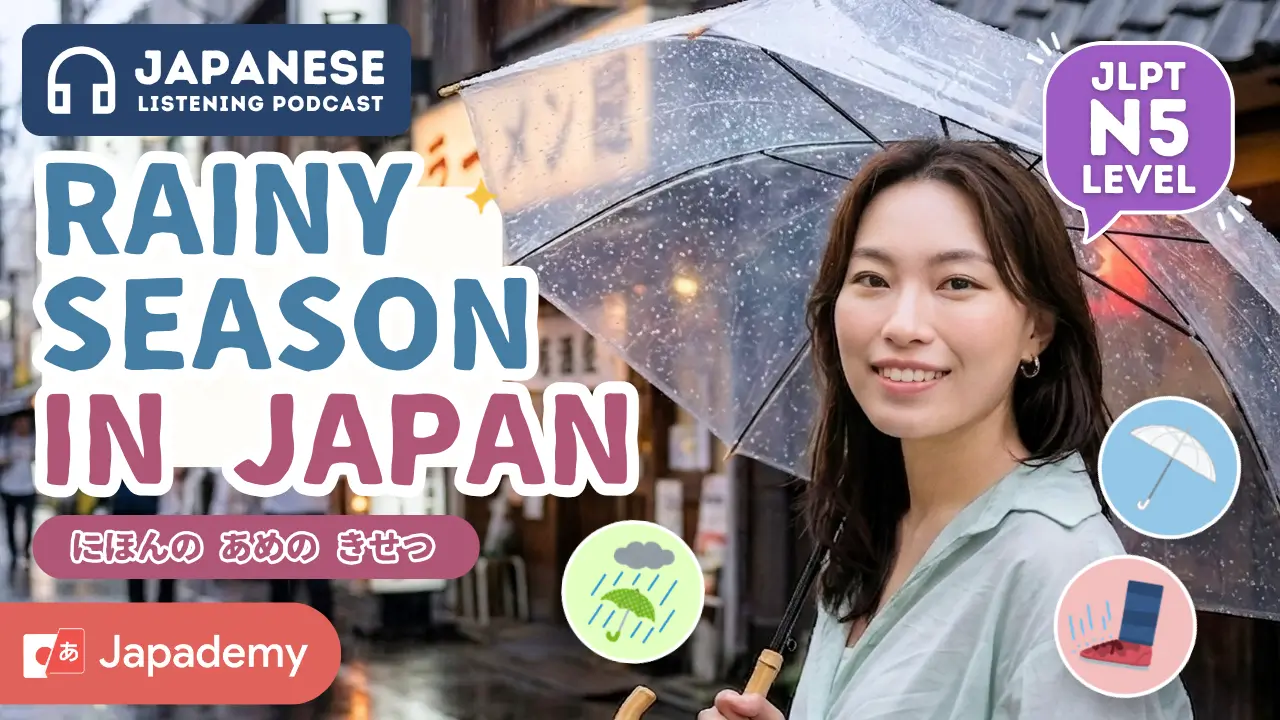


About This Episode
Japan has a rainy season and it's not just a little drizzle. In this JLPT N5 listening practice episode, I talk about 'tsuyu': when it happens, what the weather feels like, how Japanese people prepare, and the beautiful things that bloom when the rain comes.
Episode Details
Key Vocabulary
Here are the key words and phrases you will hear in this episode.
Grammar Points Covered
Using 〜たり〜たりします to list alternating actions
This pattern lists representative or alternating actions -- things that happen from time to time, or actions done in turn.
Example: あめ(雨)がふったり、くもったりします。
It rains sometimes, and is cloudy sometimes.
Using 〜より〜のほうが〜です to compare two things
This pattern makes a direct comparison between two nouns. The item after より is what you are comparing against; the item before のほうが is what you say is more [adjective].
Example: つゆよりも、なつのほうがあついです。
Summer is hotter than tsuyu.
Using 〜と〜 to express an automatic result
When と connects two clauses, it expresses a natural or automatic result: whenever the first action happens, the second follows.
Example: つゆがおわると、なつがはじまります。
When tsuyu ends, summer begins.
Episode Transcript
Follow along while you listen. Japanese script first, then the English translation below.
Japanese (日本語)
みなさん、こんにちは!かなみです。 きょうは、にほんの「つゆ」について おはなししましょう。 みなさんは、「つゆ」をしっていますか? にほんには、とくべつなきせつがあります。 それが「つゆ」です。 つゆとは、にほんのながあめのきせつです。 まいとし、このきせつがやってきます。 にほんの人(ひと)は、つゆがすきですか?
すきな人(ひと)も、すきではない人(ひと)もいます。 でも、つゆはにほんのたいせつなきせつです。 わたしも、つゆについて いろいろとおもうことがあります。 つゆは、いつはじまりますか? つゆは、だいたい6がつごろにはじまります。 そして、7がつごろにおわります。 だいたい1かげつから1かげつはんぐらいつづきます。
かなりながいですね。 にほんのみなみのほうでは、つゆがはやくはじまります。 きゅうしゅうでは、5がつにはじまることもあります。 ほっかいどうには、つゆがありません。 にほんはひろいので、きせつもちがいます。 おもしろいですね。 では、つゆのてんきはどんなかんじですか? つゆのあいだは、あめ(雨)がよくふります。
あめ(雨)がふったり、くもったりします。 はれのひは、あまりありません。 そして、しつどがとてもたかいです。 むしあつくて、じめじめしています。 ちょっとつかれますね。 でも、つゆにはきれいなものもあります。 あじさいというはな(花)がさきます。
むらさきや、あおい、とてもきれいなはな(花)です。 あじさいをみると、つゆだなあとかんじます。 では、にほんの人(ひと)は つゆのあいだ、なにをしますか? まず、かさをもちます。 つゆのあいだは、まいにちかさをもってでかけます。 かさをわすれると、こまります! わたしも、かさはいつもかばんにいれています。
そして、いえのなかではじょしつきをつかいます。 じょしつきは、しつどをさげるきかいです。 つゆのあいだは、いえのなかもじめじめします。 だから、じょしつきはとてもたいせつです。 また、せんたくものがかわきにくいです。 そとにほしても、かわきません。 だから、いえのなかでほします。
つゆがおわると、なつがはじまります。 つゆがおわったら、とつぜんあつくなります。 つゆよりも、なつのほうがあついです。 でも、はれのひがおおくなります。 つゆがおわったとき、うれしいきもちになります。 「やっとはれた!」とかんじます。 にほんのなつは、たいへんあついです。
でも、まつりや、うみ、はなびなど、たのしいことが たくさんあります。 つゆのあとのなつは、とくにたのしいとかんじます。 では、れんしゅうのじかん(時間)です! 日本語(にほんご)でこたえてみてください。 しつもんです:あなたのくにに、 ながいあめのきせつがありますか?
そして:あめのひはすきですか? それとも、すきじゃありませんか? コメントでおしえてください! たとえば:「はい、わたしのくににもあります。
でも、あめのひはあまりすきじゃありません。」 どんなこたえでもいいです。がんばってください! きょうは、にほんのつゆについておはなししました。 どのくらいわかりましたか?
もっと日本語(にほんご)を上手(じょうず)になりたいですか? リスニングのれんしゅうはとてもたいせつです。 でも、じっさいにはなす練習(れんしゅう)もひつようです。 わたしは、ジャパデミーでにほんごをおしえています。
JLPTのじゅんびコースもあります。 レッスンは少人数(しょうにんずう)クラスです。 さいだいはちにんで、先生(せんせい)がいつもすぐそばにいます。 JLPTをうけてみたいかたは、ぜひしたのリンクをみてください。 むりょうのたいけんレッスンもありますよ。
また次(つぎ)の動画(どうが)でお会(あ)いしましょう。 ありがとうございました!
English Translation
Hey everyone! I'm Kanami. Today, let's talk about Japan's rainy season -- 'tsuyu'. Have you heard of tsuyu before? Japan has a very special season -- and that's tsuyu. Tsuyu is Japan's long rainy season. It comes around every single year. Do Japanese people like tsuyu?
Some like it -- and some really don't! But it's an important part of the Japanese year. And honestly, I have quite a few thoughts about it myself. So when does tsuyu actually start? Tsuyu usually begins around June. And it ends around July. About one to one-and-a-half months long.
That's quite a long time, isn't it? In southern Japan, tsuyu starts earlier. In Kyushu, it can even start in May. Hokkaido doesn't have a tsuyu season. Japan is a big country -- and seasons vary quite a bit by region. So what's the weather like during tsuyu? During tsuyu, it rains a lot.
It's rainy one moment, cloudy the next. Sunny days are pretty rare. And the humidity is incredibly high. It's hot and sticky -- that damp, heavy feeling in the air. Honestly, it can be exhausting. But tsuyu has beautiful things too. Hydrangeas -- called 'ajisai' -- bloom.
Purple and blue, absolutely stunning. They're the flower of tsuyu in Japan. When you see them, you just know -- tsuyu. What do Japanese people do during tsuyu? First and foremost -- carry an umbrella. During tsuyu, you take an umbrella with you every single day. Forget your umbrella -- you're in trouble! I always keep one in my bag.
And at home, people use dehumidifiers. A dehumidifier lowers the humidity. During tsuyu, even inside feels muggy. That's why dehumidifiers are so essential. Laundry is also hard to dry. Hang it outside and it just won't dry. So people dry clothes indoors instead.
When tsuyu finally ends -- summer begins. And when it does, the heat comes suddenly. Summer is even hotter than tsuyu. But the sunny days come back. When tsuyu ends, there's this real feeling of relief and happiness. You think -- 'Finally, the sun is back!' Japanese summers are incredibly hot.
But there are so many great things -- festivals, the ocean, fireworks. After tsuyu, summer feels extra special. Alright -- practice time! Try to answer in Japanese. Here's the question: Does your country have a rainy season?
And: Do you like rainy days? Or not so much? Let me know in the comments! For example: 'Yes, we have one too.
But I don't really like rainy days.' Any answer is fine. Do your best! Today we talked about tsuyu. How much did you understand?
Want to get better at Japanese? Listening practice is so important -- but you also need practice speaking. I teach Japanese at Japademy --
and we have JLPT prep courses too. Classes are small -- max 8 students -- so your teacher is always right there. If you're thinking about taking the JLPT, check the link below. There's a free trial lesson too.
See you in the next video. Thank you so much for watching!
Frequently Asked Questions
Who is this episode for?
This episode is for Japanese learners at the JLPT N5 level -- typically students who have completed three to six months of structured study. If you are working towards the N5 exam or enrolled in Japademy's Pre-Intermediate course, this episode is a great fit. The pace is slow and clear, with full English subtitles and basic kanji readings throughout.
What is this episode about?
Kanami talks about tsuyu -- Japan's annual rainy season. She covers when it starts and ends, what the weather feels like, how Japanese people cope with the rain and humidity, and the beautiful hydrangeas that bloom during this season.
What vocabulary will I hear in this episode?
Key words include tsuyu (rainy season), shitsudo (humidity), kasa (umbrella), joshitsuki (dehumidifier), and ajisai (hydrangea). These are practical words for talking about Japanese weather and everyday life at the N5 level.
How do I get the full transcript for this episode?
Subscribe to our free newsletter at japademy.com/japanese-listening-practice and we'll send you the full PDF transcript for this episode, plus new episodes as they are released.
How can I keep improving my Japanese beyond listening practice?
Kanami teaches live Japanese classes at Japademy. Classes are kept small -- maximum 8 students -- so you always get personal attention from a certified native Japanese teacher. There is also a free trial lesson available. Check the link below or visit japademy.com/jlpt-online-courses.
JLPT preparation online courses
Prepare for the JLPT with certified native teachers and proven exam strategy.